Best Therapist Niches: How to Choose One That Gets Clients
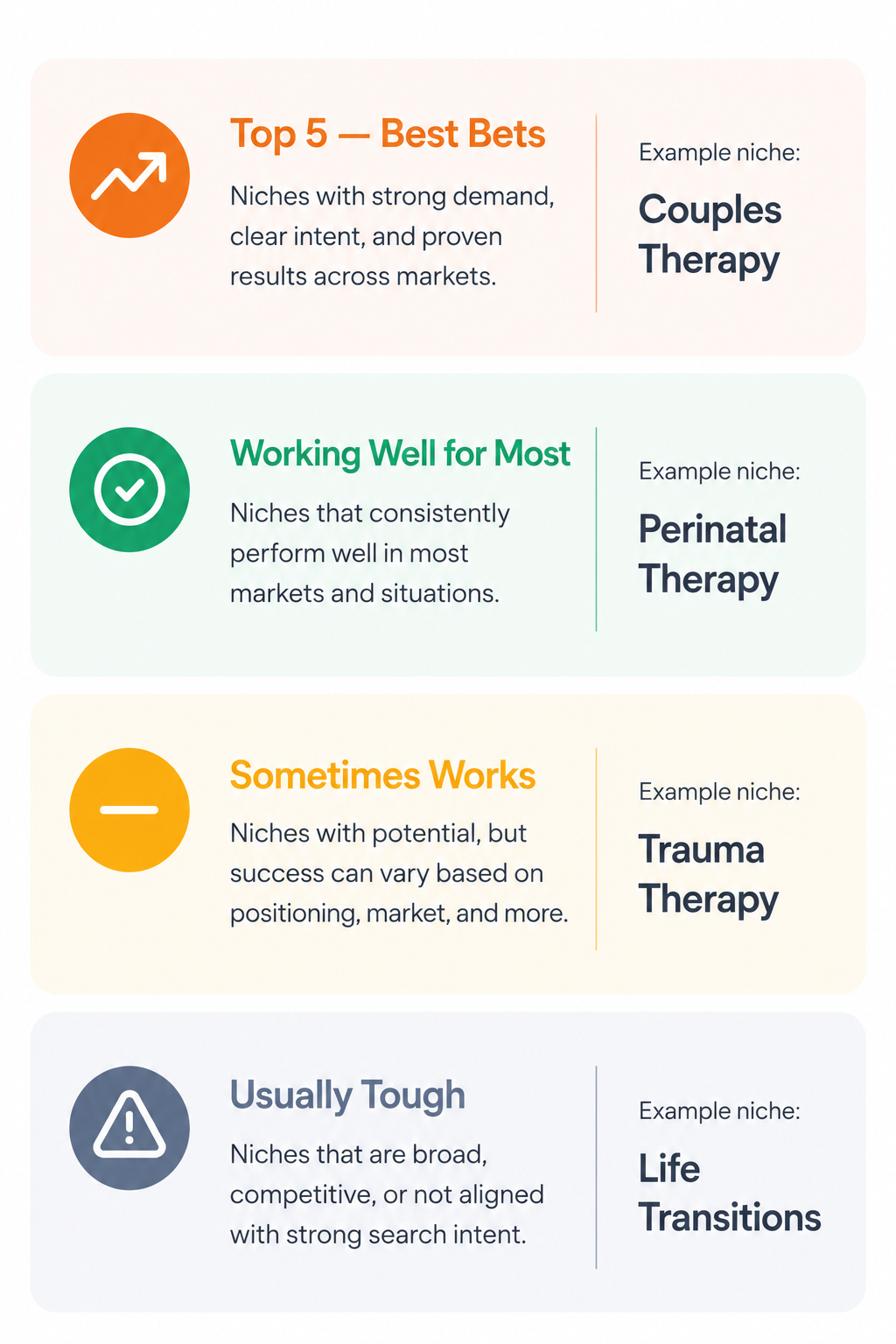
63 therapy niches ranked by Google performance data
Most advice about therapist niches isn’t wrong. It’s just incomplete.
Pick your ideal client. ✨
Speak to your dream client. 💌
Choose work that lights you up. 🤗
That advice is not wrong. You should not build a private practice around clients you dread seeing.
But it leaves out the part that matters for marketing:
People need to be looking for what you offer.
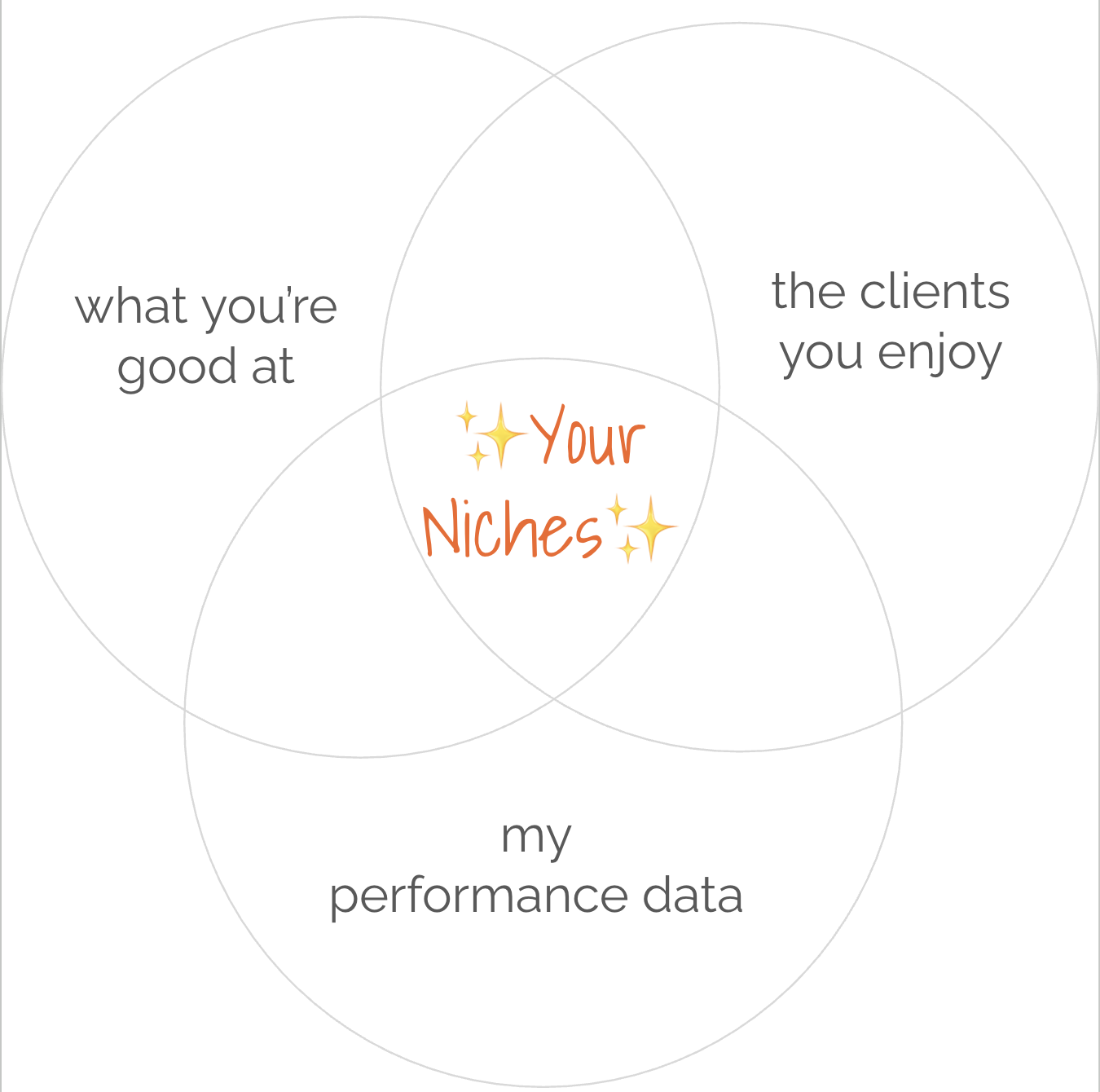
A therapy niche only helps your practice grow when it lines up with 3 things:
What you are good at
The clients you actually enjoy
What people are already searching Google for
That third part is where therapists get stuck.
A niche can sound good clinically and still be hard to market. Another niche can feel less flashy and bring in steady inquiries because clients know how to search for it.
That is why I made the free Therapy Niche Performance Report.
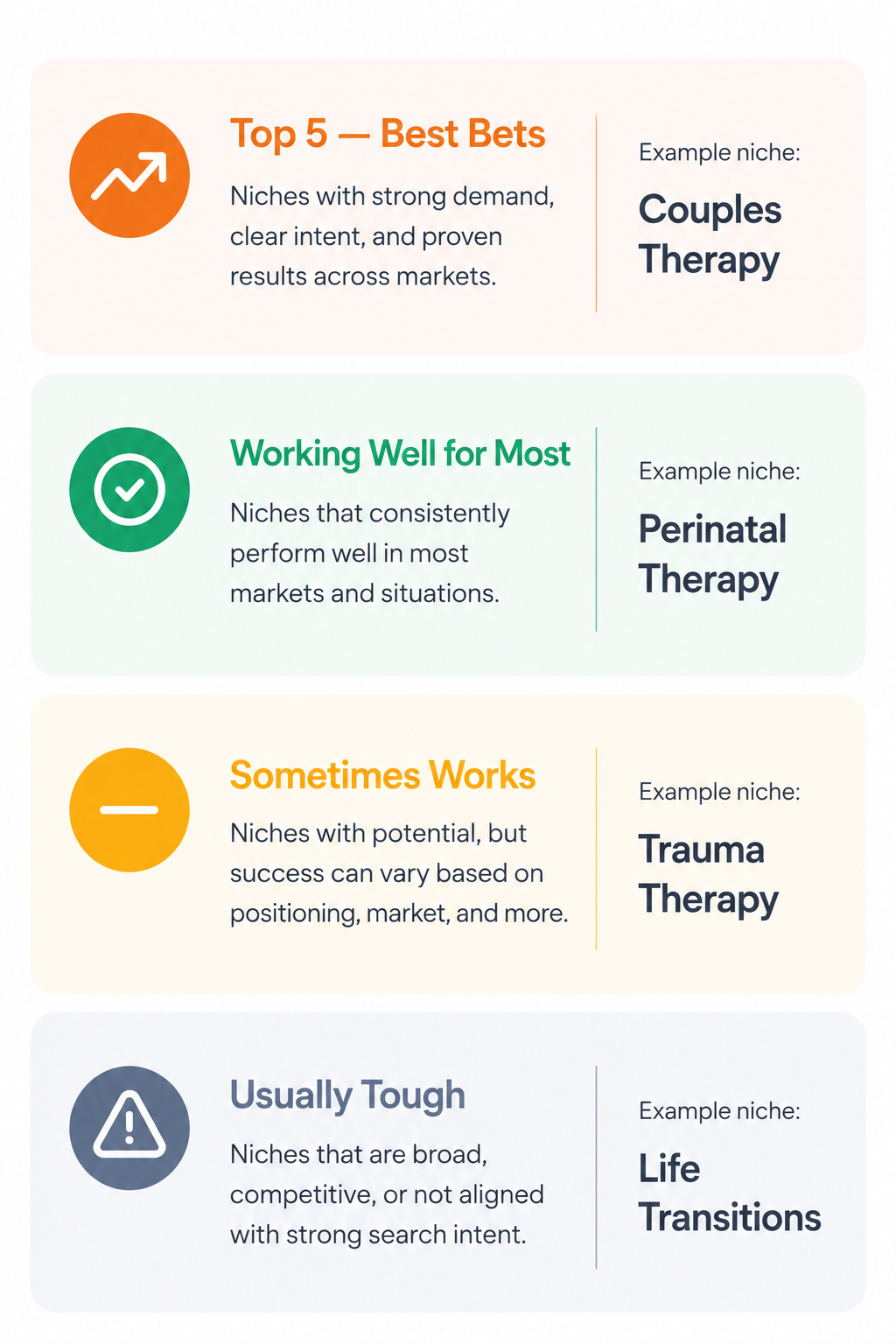
It ranks 63 therapist niches using real Google Ads performance patterns across 770+ therapy ad groups. Not opinions. Not vibes. Not “just follow your passion.”
Table of contents
Do therapists really need a niche?
Why “best therapist niches” is the wrong starting question (sorry)
What makes a therapy niche easier to market?
The niche problem most therapist websites have
How to test whether your niche has demand
What to do after you choose a niche
FAQs about therapist niches
“Broad niches usually have more competition.”
Do therapists need a niche?
No.
You can build a private practice without a niche.
But it is harder.
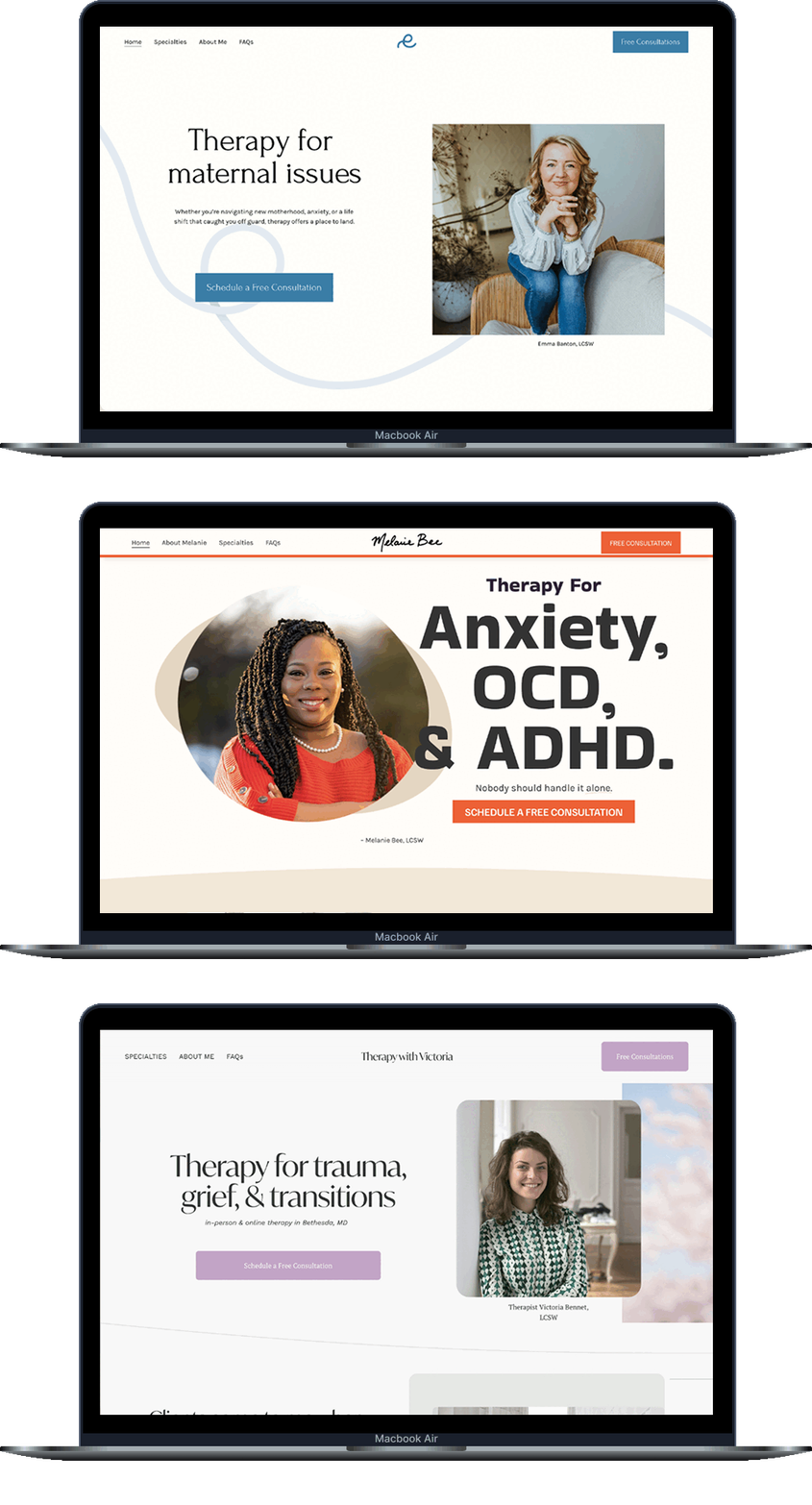
When your website says you help with anxiety, depression, trauma, relationships, life transitions, self esteem, and stress, you are technically saying something true.
But you are also saying what almost every other therapist says.
A niche gives people something specific to remember.
It also helps Google understand what your page is about.
This matters more than it used to. The Bureau of Labor Statistics projects employment for substance abuse, behavioral disorder, and mental health counselors to grow 17% from 2024 to 2034, which is much faster than average. More providers means more websites, more profiles, and more competition for the same search results.
At the same time, demand is still very real. Mental Health America’s 2025 report found that 1 in 4 adults with any mental illness reported an unmet need for mental health treatment in 2022 and 2023.
So the question is not, “Do people need therapy?”
The better question is: Can the right people find you?
And when they do find you, do they immediately understand why you are a good fit?
That is what your niche helps with.
Why “best therapist niches” is the wrong first question (sorry…)
A lot of therapists search Google for “what are the best therapist niches.” 🧑💻
I get it.
You want a list and someone to say, “Pick this niche, make this page, and your practice will fill.”
That would be nice. But it is never ever that simple. Sorry!
But there are patterns. 📈
Some niches tend to bring in inquiries faster. Some are easier for clients to understand. Some give you clearer search intent. And some are clinically meaningful but harder to market because clients do not search for them in the same language therapists use.
That is why I built the Therapy Niche Performance Guide.
The guide does not just give you a giant list of therapy niches. There are already plenty of those.
It shows how I see niches performing across real Google Ads campaigns and therapists.
What makes a therapy niche work online?
A good niche sits at the overlap of three things.
What you are good at.
The clients you enjoy.
What people are actually searching for.
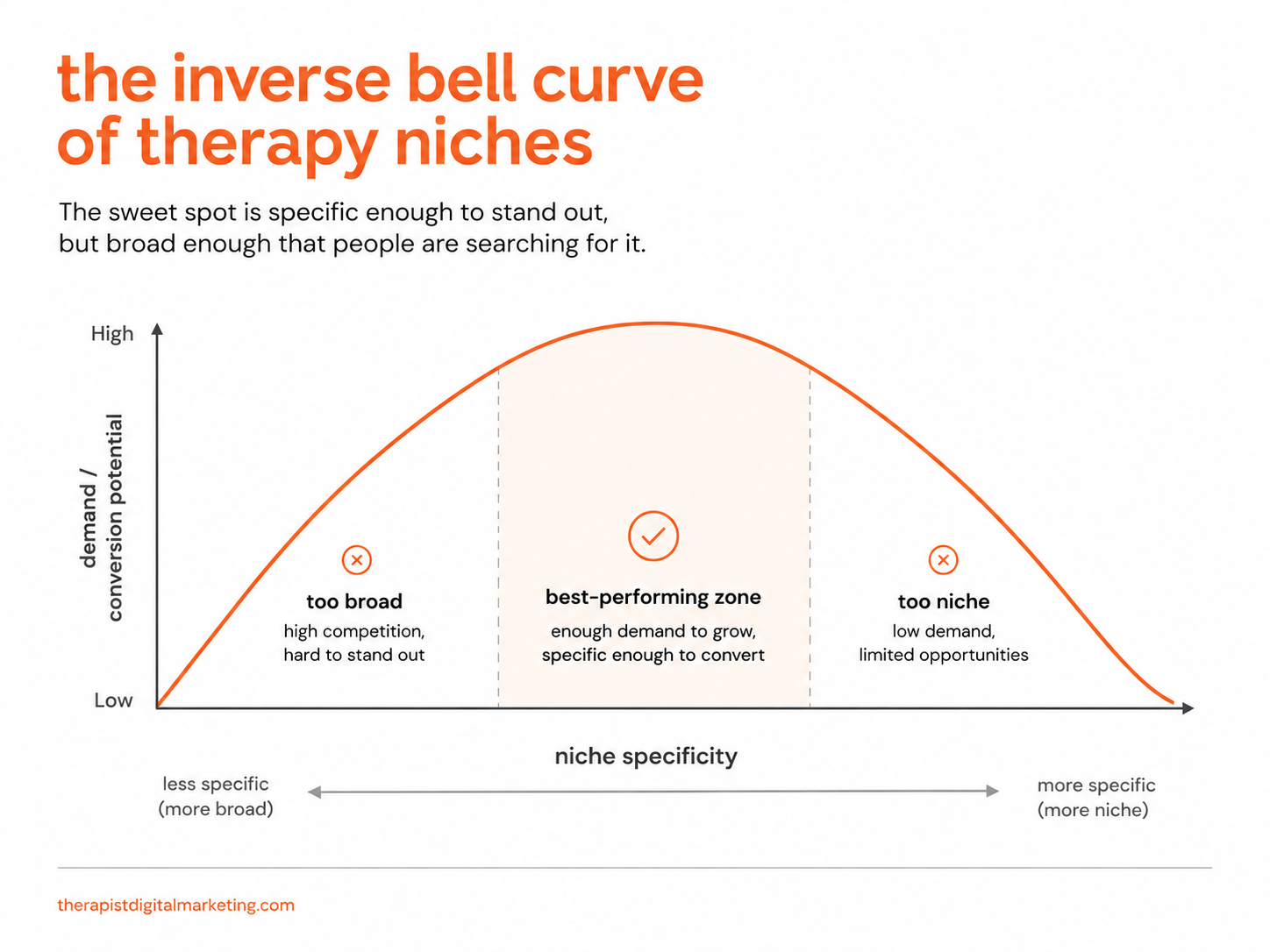
How to choose a therapist niche that is specific enough to stand out and broad enough to get searched
That last one is where people get tripped up.
A niche can feel very meaningful to you and still be hard to market. Not because the work is bad. Because clients do not know what to type into Google.
I saw that the best therapist niches tended to have a few things in common.
They are:
specific enough to stand out
broad enough that people search for them
connect to a painful problem
use words clients already understand
This is why a lot of modality based niches get tricky.
A modality can be part of your positioning. But usually clients search for the problem before they search for the modality.
It means your website needs to translate.
You can still explain your clinical approach. But the first job of the page is to meet the client where they are.
Not where you wish they were.
Why broad therapy niches are harder to rank for
Broad niches are not bad.
Anxiety therapy is not bad.
Depression therapy is not bad.
Trauma therapy is not bad.
But broad niches are crowded.
When you make a page for “anxiety therapy,” you are competing with private practice therapists, group practices, directories, national telehealth brands, hospital systems, and content sites.
That is a lot.
So if you want to rank for a broad niche, your page needs a sharper angle.
Anxiety therapy for:
who?
In what situation?
With what pattern?
In what city?
With what client language?
This is why “I specialize in anxiety” often does not go far enough.
It is not specific enough to make someone feel seen.
Why Niche Choice Matters More Now 🐴
Clients have more information.
Directories. Group practices. Telehealth platforms. VC backed therapy companies. Search results filled with ads, maps, Reddit threads, AI summaries, and giant content sites.
The therapist with the clearest message has an advantage.
In APA’s 2025 Practitioner Pulse Survey, nearly half of psychologists said they saw increased severity in client symptoms, and 46% said they had no openings for new patients.
The American Psychiatric Association’s 2025 poll found that two thirds of Americans were anxious about current events, while 40% of employed adults were worried about job security.
Clients are searching for help. And they are also overwhelmed.
Read the free Therapy Niche Performance Report
I made theTherapy Niche Performance Report because other niche advice was too vague.
I did not put the full niche rankings in this post on purpose.
The free guide goes deeper.
Inside, it goes in depth on:
63 therapist niches grouped by performance patterns
The top 5 best bets I am seeing across markets
A simple way to think about broad, narrow, and high intent niches
Practical next steps for your website
FAQs therapists ask when choosing a niche
The guide is based on performance patterns across 770+ therapy ad groups, along with therapist websites I have built and managed.
No niche works every time. Sorry!
No guide can guarantee a full caseload.
But this gives you a better starting point than guessing.
Start with now more than 10 keywords per ad group. You can expand later once you see real search terms and go for high intent keywords vs mid-funnel keywords.
FAQs
-
The best therapist niches are specific enough to help you stand out, but broad enough that clients actually search for them.
They also connect to a problem people feel clearly enough to seek help.
I rank 63 therapy niches in the Therapy Niche Performance Report.
-
Technically no, but it practice - yes.
A niche gives Google a clearer topic to understand. It also helps clients recognize themselves faster.
Broad pages can rank, but they are more competitive.
-
A headline that matches the search, who you help, how you work, practical logistics, and a clear next step. Keep it simple and direct.
-
For solo therapists, 3 strong niches is usually enough.
You can go up to 5 if they connect clearly. After that, the word “specialty” starts to lose meaning.
-
Keep them if you want. You do not need to delete work you care about. But if a broad niche is competitive, balance it with more specific pages that help you stand out.
-
Search for it like a client would. If you see therapist websites and ads, that is usually a sign there is demand. If you mostly see articles or resources, the niche may need to be reframed in more client friendly language.
